
The environmental hygiene stability framework
Modern facilities operate as dynamic systems. Occupancy density, airflow patterns, surface interaction, humidity variation, and chemical application cycles continuously influence environmental stability.
Traditional cleaning models focused on visible results. Institutional environments require a structured approach that integrates environmental variables, calibrated protocols, and measurable verification.
Environmental hygiene is not cosmetic maintenance.
It is environmental stability management.
This framework evaluates facilities as systems rather than isolated tasks. By mapping exposure patterns, calibrating protocols to facility context, monitoring environmental indicators, and documenting variability over time, it supports consistent and accountable environmental oversight.
Environmental hygiene programs operate within defined scope and support environmental stability without replacing laboratory diagnostics or clinical infection control services.
Structured environmental management for institutional environments.
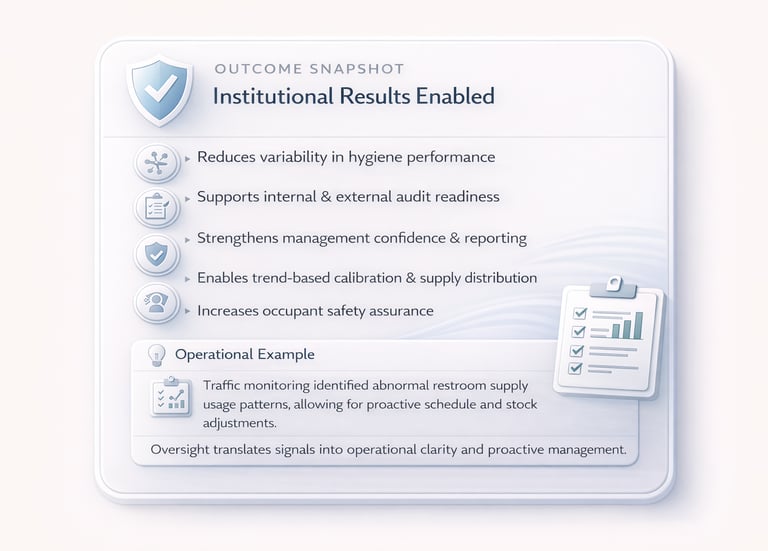
• Reduces variability in hygiene performance across high-traffic zones
• Supports internal and external audit readiness through documented verification
• Strengthens operational confidence and protocol consistency
• Provides repeatable environmental monitoring and trend insight
• Increases occupant safety assurance through calibrated oversight
Institutional Outcomes Enabled
In shared facilities, traffic-based monitoring and supply documentation have enabled early identification of abnormal consumption patterns. Rather than reacting after several days of overuse, calibrated tracking allows proactive adjustment of frequency, distribution, and oversight — improving resource control and operational efficiency.
Structured environmental documentation has also supported proactive adjustment of high-traffic restroom schedules and supply allocation, reducing variability and preventing reactive service escalation.
Environmental oversight is not only about cleanliness — it is about measurable facility stability
• Reduced corrective maintenance
• Improved material lifespan
• Controlled environmental variability
• Documented hygiene stability
Environmental Mapping
Traffic density analysis
Airflow awareness
Humidity condition review
Protocol Calibration
Chemical selection (Label aligned)
Control dilution
Dwell time alignment
Frequency scheduling
Controlled Implementation
Protocols are executed with disciplined consistency. All personnel operating within institutional environments are trained in chemical handling accuracy, dwell-time adherence, surface compatibility, and environmental variable awareness
Verification & Documentation
ATP indication (where appropriate)
Humidity monitoring
Schedule validation
Reporting structure
Continuous Adjustment
Trend review
Variability recalibration
Environment updates
Environmental Hygiene stability through controlled repetition- not intensity









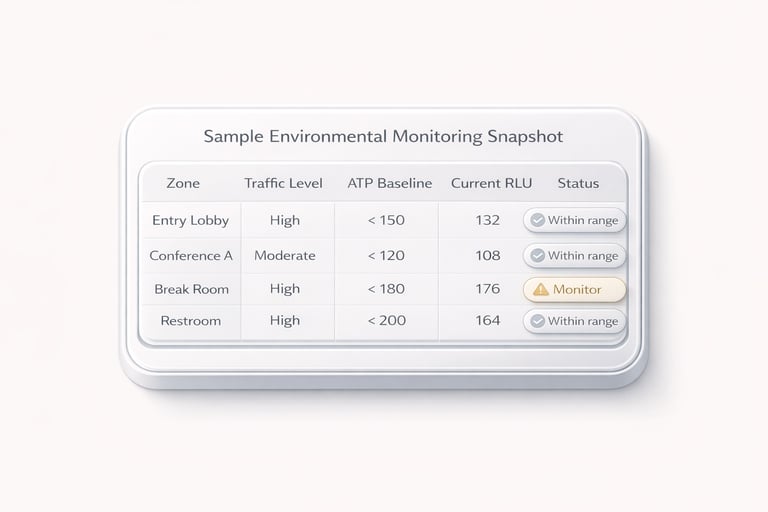
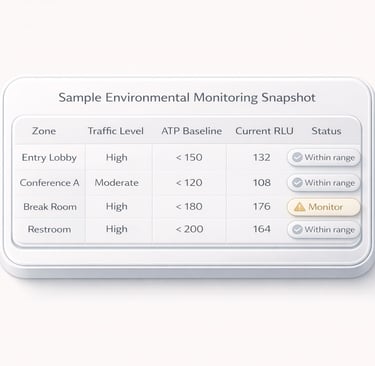
Baseline ATP readings are established per facility and calibrated by zone, reflecting environmental context rather than generic universal thresholds.
Environmental hygiene programs operate within defined operational scope. They support environmental stability and risk reduction but do not replace laboratory diagnostics or clinical infection control services.
Airflow patterns identified early in mapping inform frequency and zone prioritization based on re-contamination expectations.
Environmental readings are reviewed periodically to identify variability trends and support protocol adjustment where needed.
Zones are prioritized not only by contact frequency but also by exposure risk profiles to guide monitoring and intervention intensity.
Dilution practices follow manufacturer labeling and are supported by calibrated measurement systems or controlled manual procedures.
Calibration minimizes variability while protecting both surface integrity and personnel safety.
Environmental hygiene is not task execution — it is environmental stability management.
This mapping informs risk prioritization — ensuring controls are allocated where exposure variability is highest.
Environmental risk prioritization is informed by contact frequency and exposure profiles — a principle supported by infection prevention frameworks.
+
Case Example: Multi-Occupancy Professional Office
Facility: 18,000 sq ft corporate office
Occupancy: 120 daily staff
Primary concern: Hygiene consistency and high-touch variability
Assessment findings:
• High-traffic entry and conference zones under-calibrated
• Humidity averaging 68% during peak occupancy
• Dwell time inconsistently observed
Protocol adjustments:
• Traffic-based frequency recalibration
• Controlled dilution system implemented
• Humidity monitoring introduced
• ATP baseline established for high-touch zones
Outcome:
• Improved protocol consistency
• Reduced variability in high-touch surface readings
• Documented hygiene program for internal reporting
Zones are prioritized based on contact frequency, population exposure, and operational sensitivity.
Environmental indicators are reviewed periodically and compared to facility-specific baselines.
Humidity Range: 45–55% target
Current: 52%
Status: Stable
ATP values represent organic load indication and are used for protocol consistency monitoring.
Environmental hygiene programs operate within defined scope and support environmental stability and risk reduction without replacing laboratory diagnostics or clinical infection control services.
Baseline ATP readings are established per facility and calibrated by zone to reflect operational context rather than relying on universal thresholds, and measurements are periodically reviewed over time to identify variability patterns and refine protocol application.
Environmental readings are reviewed periodically to identify variability trends and inform protocol adjustment where necessary.
Structured environmental oversight reduces operational variability, supports audit readiness, strengthens staff safety confidence, and increases institutional accountability.
A formal assessment allows environmental variables to be calibrated before recommending protocol adjustments.


This content draws on established material science principles and industry best practices in surface maintenance and chemical compatibility.
Facility Environmental Hygiene & Stability Assessment
A structured assessment allows us to quantify environmental variables, calibrate protocols to facility context, and recommend targeted actions — empowering operational confidence and reducing variability in hygiene outcomes.
Reach out for thoughtful, expert cleaning care
Technical paper- Material Compatibility & Surface Stability in Repeated Service Environments